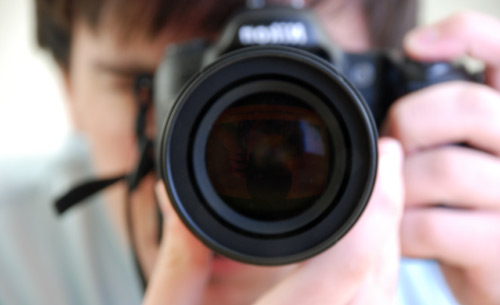
Cameras have always been close to my heart. It all started when my dad bought me a disposable camera so I could take my own pictures during our family vacation to Hawaii. That was the year of 1997 when I was only 5 years old. The 27 frames that the 35 mm film held, introduced me into the world of photography. Soon after I had my very own first camera, a Nikon F60 SLR, it was a Christmas present, a good one at that! Being a photographer and a technology enthusiast, I am always interested in advances related to cameras.
Today, SLRs are almost obsolete, only people that truly respect and appreciate the technology still use them. DSLRs occupy the market now; there is no more film, it's all digital. In fact, even that statement is a stretch. DSLRs are the only thing on the market, but almost nobody buys them anymore, only professional photographers do. So what do ordinary people take pictures with you ask? Phones! People don't want to carry multiple devices on them, and they don't have to! Ever since the introduction of the iPhone in 2007, people use their smartphone cameras.
Just like anything else in the world of technology, smartphones, and their cameras, are constantly being redesigned and improved. Since majority of people own smartphones and use their cameras everyday I wonder how good those cameras are. Obviously, they have to be pretty good because everyone uses them! I am also interested in how the smartphones compare to each other and whether their rate of advancement is adequate enough. So let's get to it!
I carry around an iPhone 5 which was released in September of 2012. My bother carries my old hand-me-down iPhone 4 which was released in June of 2010; 2 years apart. Let's talk about the internals of their cameras.
Both iPhones have a 1/32" (4.54x3.42 mm) sensor size and a 5x digital zoom. iPhone 4 has a 1.75 µm pixel size, 3.85 mm focal length and a F/2.8 aperture, while the iPhone 5 has a 1.4 µm pixel size, 4.10 mm focal length and F/2.4 aperture. Given these figures we can calculate the amount of mega pixels iPhone 4 and 5 have: (2592 x 1936) 5 MP and (3264 x 2448) 8 MP, respectfully.

So what do these numbers tell us? In the world of smartphones, they are competitive. You would find about the same cameras in other phones around those two years. But in comparison to actual consumer-grade DSLRs they are about 2 or 3 years behind. By no means are they revolutionary or comparable to professional cameras but they are a tenth of a size and considerably cheaper. That's where you have to draw the line. If you were in photography contest you wouldn't be using your phone, but most people are not professionals. This is why smartphone cameras occupy majority of the market; they are more than enough for quick pictures that most people take.
For my comparison of the two iPhones I will take 5 kinds of pictures with 3 zoom intervals. I will take a picture of
- a white sheet of paper
- a black sheet of paper
- half black half white
- a well lit outdoor picute
- a dim outdoor picture
- indoor picture
Once I have the pictures taken, I will compare their file sizes, ISO and shutter speeds.
This week I will compare the pictures of white, black and half white half black. Since black contains all of the colors, I am curious if it's file size will be much bigger than whites and in the half white half black picture if the file size will he half smaller. Obviously I do not have optimal lighting conditions so white may look gray at times, adding more colors than just pure white and contributing to a difference in file sizes, but I did the best I could. Let's get started.
iPhone 5 iPhone 4
 | |||||||||
| 1.2 MB ISO 3200 Shutter speed: 1/15 no zoom |
 |
| 772 KB ISO 1000 Shutter speed: 1/15 no zoom |
 |
| 688 KB ISO 3200 Shutter speed: 1/15 half zoom |
 |
| 638 KB ISO 1000 Shutter speed: 1/15 half zoom |
 |
| 485 KB ISO 3200 Shutter speed: 1/15 full zoom |
 |
| 492 KB ISO 1000 Shutter speed: 1/15 full zoom |
 |
| 2.2 MB ISO 200 Shutter speed: 1/20 no zoom |
 |
| 1.8 MB ISO 80 Shutter speed: 1/17 no zoom |
 |
| 1.3 MB ISO 200 Shutter speed: 1/20 half zoom |
 | |||||
| 1.1 MB ISO 80 Shutter speed: 1/20 half zoom |
 |
| 929 KB ISO 200 Shutter speed: 1/15 full zoom |
 |
| 689 KB ISO 80 Shutter speed: 1/20 full zoom |
 |
| 1.2 MB ISO 1600 Shutter speed: 1/17 no zoom |
 |
| 1.7 MB ISO 1000 Shutter speed: 1/15 no zoom |
 |
| 1.0 MB ISO 1000 Shutter speed: 1/15 half zoom |
 |
| 1.2 MB ISO 800 Shutter speed: 1/15 half zoom |
 |
| 817 MB ISO 800 Shutter speed: 1/15 full zoom |
 |
| 656 KB ISO 1000 Shutter speed: 1/15 full zoom |
I'm actually surprised with the results. First and foremost, I was expecting pictures of black color to be bigger in file size than of whites, but in fact they were about 50% smaller. Black contains all colors whereas white doesn't contain any. I was curious if that would be reflected by the file size, and apparently it is, but it's complete opposite of what I thought it would be.
iPhone 4 has 5 megapixels and the iPhone 5 has 8 megapixels, a 37.5% increase. I was curious to find out whether or not the file sizes would show the same correlation. They don't, the file sizes range anywhere from 15% to 35.7% increase.
Another interesting observation, which I was anticipating, is that pictures of white have a very small ISO speed whereas blacks have very high ISO speed.
Onto the zoom, obviously the further you zoom the more granulated the picture becomes, especially with digital zooms. I was expecting the file sizes to decrease about 50% at mid and full zoom and for the most part they do, it's not exactly 50% each time but based on this data I think it is save to make the assumption that they generally do. There is one outlier to this generalization, on iPhone 5, the picture with no zoom and half zoom on half white half black did not change in file size; I am not exactly sure as to why.
Last but not least, the half black half white pictures. I wanted to find out if they will be half the size of a pure color. As I said before, I thought it would be black that's larger than white in file size but that's reversed. The pictures are not half of the file size, but they are in-between the two, which makes sense.
All in all, I got a lot of unexpected results. Now that I have what I think is a foundation, I wonder if I will see similar results with actual pictures of objects next week. I wonder if dimmer pictures will have a bigger file size and higher ISO speed... We'll see!
Until next week!
-Mario


Hey Mario, I have a few comments and a question
ReplyDeleteI think I can explain why the jump from 5 megapixels to 8 megapixels did not account for a 37.5% file size increase. The exact reasoning has to do with the way an image is compressed. Image compression works by taking a raw image, and finding the similarities in the image and using repetition to keep the image size down. Image compression works really great on simple images like the all black images taken by the cameras. Also, I noticed that your predictions on how black may take up more space because it contains all the colors. Computers and smartphones use the RGB color model to store and display images, so each color takes the same amount of space to store as the next (see http://en.wikipedia.org/wiki/RGB_color_model). I have just one last question:
Why were the images taken in this post so simple? Is this a common way to compare images from different devices, or is it just easier to compare, or both?
Overall, this is a great post. It was interesting hearing about the history of the SLRs became obsolete and your first experiences with a camera.
Thanks for the great insight! I wanted to start off with white and black to have a "pure" base image for comparison. My thought process was that white will be as pure as a bright image can get, and black will be as dark as it can get. I wanted to get the absolute 2 ends of the spectrum; which I didn't really achieve because I didn't have optimal lighting conditions. You pointed out that based on the RGB color model there shouldn't be any differences, but there were(whether they are accurate or not). I'm curious if I see a correlation with dim and bright images next week.
ReplyDeleteHi, Mario. I wanted to say that I completely agree with you when you say that people tend to be more intereseted in having all of their electronics in one device, than they are in the actual performance of their electronics. At what point do you think Apple and other phone developers will stop incorporating camera upgrades into their new releases. After all, isn't 8 mp more than enough for the casual Instagram or Snapchat user?
ReplyDelete